Blog
Understanding Deliverability: Spotting the Warning Signs
How monitoring can help to identify deliverability issues early on – and why we should reconsider deliverability
The examples in this article are based on real-life cases from the CSA Certification Monitor, our monitoring tool which analyses data from mailbox providers and gives senders transparency over their mail stream.
Deliverability problems rarely come out of the blue
Many senders describe deliverability issues as something that “happens suddenly”:
Inbox placement drops, complaint rates rise, and campaign performance deteriorates.
But in reality, this almost never happens.
Deliverability issues do not strike overnight. They develop – and they have warning signs.
So, the crucial question is not whether these signals exist. But rather: do we spot them in time?
Deliverability is not an outcome – but a signalling system
When it comes to deliverability, we often focus on the visible results:
- inbox vs. spam
- reputation scores
- campaign performance
However, these are merely symptoms.
Taken individually, they are often unremarkable. Together, they paint a clearer picture.
The challenge lies in accessing the right data and linking it in a meaningful way.
What do these signals actually look like?
Signals are not abstract — they appear directly in the email streams.
Typical examples include:
- authentication errors (e.g. DKIM issues)
- sudden spikes in complaints
- spam trap hits
- changes in inbox placement
None of these signals automatically indicates a problem.
However, they are early warning signs. Those who ignore them usually react too late.
From signal to insight: why monitoring is crucial
Most organisations already have access to a wealth of data and are literally hoarding it.
The problem is rarely a lack of information, but rather a failure to utilise and interpret it.
This is where monitoring comes in. Effective monitoring enables:
- early identification of trends and anomalies
- the isolation of affected shipments
- risk assessment
- a faster, more targeted response
In short, monitoring turns data into actionable insights.
How signals manifest themselves in practice
The real added value becomes clear when you look at specific examples.
1. Configuration issues are often immediately apparent
As can be seen in the following chart, an increased rate of DKIM errors was detected.
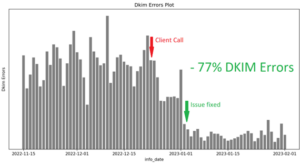
Without this early visibility, problems with the sender’s reputation would have become entrenched.
2. Spikes in complaints have causes
Complaints rarely rise for no reason.
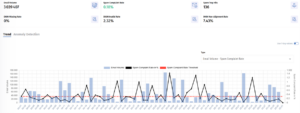
The Certification Monitor made it possible to identify the affected email flow and pinpoint the actual cause, whether that be issues with authentication, targeting the wrong audience or poor data quality.
This enables targeted measures to be taken at an early stage.
3. Spam traps are a clear warning sign
Spam trap hits are often an indication of issues with list quality.
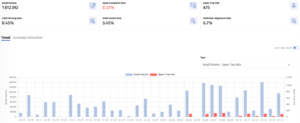
In this example, it is clear that an increase in email volume from 4 February has led to a rise in spam trap hits. The data source and the age of the email addresses should be checked, and targeted list hygiene measures should be initiated before any major damage occurs.
4. Inbox placement shifts gradually
Deliverability does not change overnight.
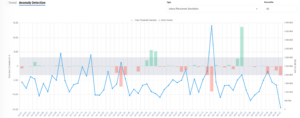
Significant deviations from normal behaviour can often be detected early on, long before inbox placement deteriorates noticeably. In the above example, the negative spikes (the large red bars) in particular should be investigated. This is because the inbox rate dropped here, which differs from normal fluctuations.
This buys valuable time to take corrective action.
5. External peaks exacerbate existing weaknesses
Events such as Black Friday demonstrate just how sensitive deliverability setups are.
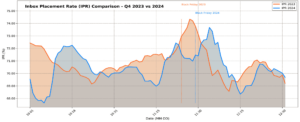
Mailbox providers expect higher sending volumes during such events, and in the short term, better inbox rates are often measured.
After the peak, however, weaknesses become apparent:
- more spam trap hits
- more spam complaints
- lower engagement
These are not exceptions; they simply highlight existing problems that have been exacerbated by this exceptional situation.
Read more in our data analysis on Black Friday Q4 2023/2024.
6. Growth can also pose a risk
A sudden surge in new registrations may seem positive at first.
However, if the number of complaints increases at the same time, this is often an indication of problems, such as automated registrations or bot attacks on forms. Without monitoring, such patterns often go undetected until your reputation suffers.
Why signals are crucial: from reacting to managing
Deliverability issues always leave their mark. There are no ‘silent failures’.
The difference lies not in whether problems occur – but in how early they are detected.
Close monitoring enables:
- continuous visibility into the mail stream
- early detection of risks
- faster and more targeted measures
- sustainable improvement rather than symptomatic fixes
Deliverability is not a one-off setup
An important shift in perspective is:
Deliverability is not something you simply ‘set up correctly’ once and for all. It is an ongoing process. Signals are not just warnings, they provide feedback.
Combined with expertise, they enable:
- better decisions
- more stable sending processes
- a stronger reputation in the long term
Conclusion
Deliverability doesn’t suddenly collapse.
It develops – and it sends signals.
The crucial question is not whether these signals exist.
But rather:
- whether we see them
- whether we understand them
- and whether we act in time
Because when deliverability fails visibly, the warning signs were there all along and were overlooked.